Posts

Romanticism

Image
     The Romantic Era is my favorite segment of Art History.  It's my personal philosophy that all great art elicits some sort of emotion out of the viewer or can communicate the emotion to the viewer and a lot of romantic artists seem to agree.  One of the biggest hallmarks of the Romantic Era was the heavy use of emotions and emotional subjects as a reaction to the Neoclassicism style that came before it. Caspar David Friedrich, Wanderer above the Sea of Fog , 1818 Alexandre Cabanel, Fallen Angel , 1847     Two great examples of the Romantic style are Caspar Friedrich's Wanderer Above the Sea of Fog  from Germany, and Alexandre Cabanel's Fallen Angel  from France.  I chose these pieces to illustrate the emotional aspects of the Romantic style because they both portray emotions in a beautiful way, but as nearly polar opposites of each other.  Friedrich's work is deeply foreboding, the dense fog underneath the wanderer gives the roc...
Classical Revolt

Image
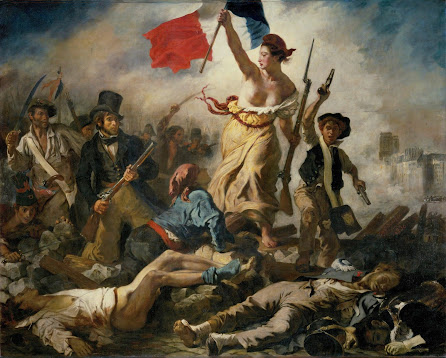
     The 18th century to mid 19th century was a political firestorm worldwide.  Also called the "Age of Revolutions", in just around 150 years we got Circassian, Industrial, American, French, Haitian, and Serbian Revolutions, just to name a few.  Revolutions are many things, but one thing they are most certainly not is clean.  Social and political upheavals are messy and brutal, especially during this time period.  American soldiers fighting and dying for freedom en masse, and only a few years later the French aristocracy starts coming in 1st place at the Headless Horseman look-alike contest thanks to  Joseph-Ignace Guillotin 's most famous invention .  This was a gritty and savage period in history, which is why it's very interesting to me that dozens of artists depicted moments from this period through a brighter, more glorious lens. Eugene Delacroix, Liberty Leading the People , 1830, Oil on Canvas     A fantastic example of thi...

If It Ain't Baroque...

Image
     The Baroque Period is a very interesting section of Art History. Around the mid to late 1500s, the Catholic Church was starting to get a bit worried about the increasing popularity of Lutheranism in the populace. In response, they convened the Council of Trent, the 19th ecumenical council of the Roman Catholic Church, in Trento, Italy.        The Council's main objective was to be a counter-reformation to the Protestant reformation and revitalize the public's interest in Catholicism.  One of the ways it went about doing this was, in essence, advertising to the uneducated masses through visual art.  Since a very large portion of the population was illiterate, it made sense to try to connect to them through mediums that didn't require reading.  There was a sudden push from the Church to the artists of the time to create works that inspired awe in the public, while at the same time grounding iconic biblical scenes to make them...

Northern Renaissance: Bosch's Garden

Image
  Hieronymus Bosch, The Garden of Earthly Delights, oil on oak panels, 1505      Hieronymus Bosch is known for many things, the many works he created in the late 1400s and early 1500s, having a name that sounds like a spell from Harry Potter , and creating possibly the most famous triptych to come out of the Northern Renaissance, The Garden of Earthly Delights .  However, while we know of his many works, knowledge about the man behind the brush is surprisingly scarce.  Even so, much of Bosch's character and beliefs come through when examining The Garden of Earthly Delights.     The work is a triptych, oil paintings created on three hinged wooden panels, the two outer panels folding in on the inner panel.  What is surprisingly rarely discussed is the fourth panel of the triptych, only viewable when the outer panels are closed. Hieronymus Bosch, The Garden of Earthly Delights (closed) Starting with the triptych closed is how I believe that Bosc...

Elements of Art Assesment

Image
     Art is a very tricky thing to define, as it means many things to many people.  In my personal philosophy, I believe that genuinely great art serves as a catalyst for emotions in those consuming it.  It sets out to use its elements to tailor an emotional experience in the viewer and it is my personal belief that one of the best examples of molding a viewer's emotions is 2011's,  Dark Souls. Dark Souls EU Cover Art      Dark Souls is an action-adventure role-playing video game developed by the Japanese studio FromSoftware and directed by genre veteran Hidetaka Miyazaki .  It sounds like an odd choice, I know, but don't pass judgments just yet .  Dark Souls has a fantastic understanding of techniques such as color, value, and perspective and it uses these elements to craft a unique and immersive experience worthy of artistic analysis.  To demonstrate this, let's take a look at the game's introduction along with two areas in...

Introduction

Image
 My name is Garrett.  I was born and raised in Fairbanks, Alaska.  Most of my interests are related to comics, horror movies, unsolved mysteries, and art.  I am currently twenty years old and I hope to eventually get a degree in Art with a minor in creative writing, and I have an online store where I sell some of my designs. Li I (1974), by H.R. Giger      I have been drawing since a pencil could fit into my hand, and my personal favorite medium to work in is pen and ink with Microns and dip pens.  I am mainly interested in horror and thriller-based content.  I grew up fascinated by films such as "Alien" (1979) and "Hellraizer" (1987), and their aesthetics helped to shape my art style.  Naturally, I reference the creative minds behind the visuals of those films, H.R. Giger and Clive Barker, as significant influences on my style and creative process, along with artists with similar aesthetics such as  Masahiro Ito  and  Zdz...